

Today BYSO serves over 600 children throughout New England, and is recognized as one of the finest youth orchestras in the country. The timeline below highlights some of the most memorable moments in the history of BYSO.
1958
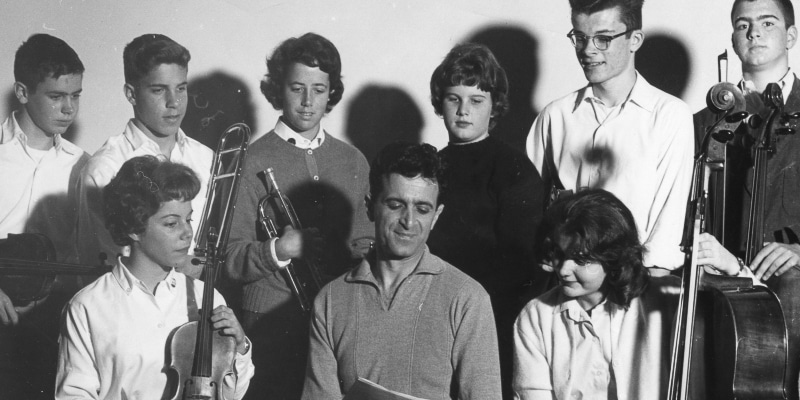
Dr. Robert Choate of Boston University leads the effort to establish a youth orchestra for junior and senior high school aged musicians. Marvin Rabin is appointed Music Director, and the orchestra’s debut concert takes place at New England Conservatory’s Jordan Hall.
1962
BYSO (formerly known as The Greater Boston Youth Symphony Orchestra or GBYSO) performs at the White House and at Carnegie Hall.
1963
A second full orchestra is established due to the demand created by the number of auditioning students; now known as the Repertory Orchestra, this group was originally called the Greater Boston Junior Youth Symphony Orchestra.
1964
Junior and Senior orchestras perform works by Bach, Brahms, Sibelius and others for the first time at Symphony Hall. Dr. Artin Arslanian is appointed Music Director.
1967
Walter Eisenberg appointed Music Director.
1969
GBYSO earns top honors at the first International Festival of Youth Orchestras in St. Moritz, Switzerland on its first international tour.
1970
GBYSO is the first foreign youth orchestra to perform at the prestigious Israel Festival of Music and Drama.
1972
GBYSO performs at the Kennedy Center in Washington D.C. and later tours England, Scotland, and Wales.
1974
GBYSO travels to Colombia to perform in Bogota and Medellin (Boston’s sister city).
1978
Members of the orchestras share music stands with Boston Symphony Orchestra (BSO) musicians in five Youth Concert performances of Tchaikovsky’s 1812 Overture under the direction of Harry Ellis Dickson at Boston’s Symphony Hall.
1979
GBYSO returns to Colombia by popular demand.
1980
GBYSO participates in an exchange with the Düsseldorf Youth Symphony Orchestra and tours West Germany and Belgium. Leonard Atherton is appointed Music Director.
1982
GBYSO tours Montreal; the trip includes a joint concert with the Montreal Youth Orchestra. Eiji Oue is appointed Music Director. The organization’s highest-level orchestra becomes informally known as the Senior Orchestra.
1983
Silver Anniversary celebrations include the commission and premiere of The GBYSO Music by Theodore Antoniou and a tour of France. GBYSO becomes an independent non-profit organization.
1985
The Senior Orchestra’s tour of Yugoslavia, Hungary, and Austria includes a performance in Budapest for the International Congress of Physicians for the Prevention of Nuclear War, as well as an appearance at the Dubrovnik Music Festival.
1988
Leonard Bernstein and Seiji Ozawa serve as honorary chairs of the Senior Orchestra’s tour of Japan. The Senior Orchestra commissions and performs the world premiere of The Gesar Legend by Peter Lieberson for five soloists. The soloists are Sato Knudson, Ronan Lefkowitz, Richard Sebring, Fenwick Smith, and Larry Wolfe, all BYSO alumni in the BSO.
1989
David Commanday appointed Music Director.
1991
The Junior Repertory Orchestra (JRO) is established.
1992
The Senior Orchestra tours Central Europe. After the tour, the American Society of Composers and Publishers (ASCAP) presents the BYSO a special award given in recognition of the programming of American music on foreign tours. The Senior Orchestra performs Mahler’s Symphony No. 2 at Symphony Hall in a special Benefit Concert for the Children’s AIDS Program. The concert is named the Best Concert of the Year by an orchestra other than the BSO by the Boston Globe.
1993
The Senior and Repertory Orchestras undertake an exchange with the Chicago Youth Symphony Orchestras. The trip to Illinois features a performance at Chicago’s Orchestra Hall.
1994
The Senior Orchestra tours Finland and Sweden. The Repertory Orchestra travels to Minnesota on its first solo tour; the trip is part of an exchange with the Minnesota Youth Symphonies.
1995
Violinist Lynn Chang and cellist Yo-Yo Ma join the Senior Orchestra for the world premiere of Ivan Tcherepnin’s Double Concerto for Violin, Cello, and Orchestra, a work commissioned by the BYSO. The Preparatory String Orchestra, now known as the Young People’s String Orchestra (YPSO), is established.
1996
Ivan Tcherepnin’s Double Concerto for Violin, Cello, and Orchestra wins the highly coveted University of Louisville Grawemeyer Award for Music Composition; BYSO was the first youth orchestra organization to be affiliated with this prestigious award. The Senior Orchestra tours Italy with a featured performance at the world renowned Ravenna Festival.
1997
Named by National Public Radio’s Performance Today as one of the nation’s five best youth orchestras.
1998
Celebrates its 40th Anniversary. The Senior Orchestra travels to England and Ireland for a six-concert tour.
1999
Ranked #1 out of 45 applicants by The Massachusetts Cultural Council (MCC). The Senior Orchestra performs at Seiji Ozawa’s Twenty-Fifth Anniversary Celebration with the BSO on the Boston Common. Federico Cortese is appointed the Music Director.
2000
The Senior Orchestra tours France. Both the Senior and Repertory Orchestras perform at Symphony Hall during the venue’s Centennial Celebration. The Senior Orchestra participates in an exchange with the Chicago Youth Symphony Orchestras.
2002
First time collaboration with the Tanglewood Festival Chorus, the official chorus of the BSO. The Senior Orchestra tours the Czech Republic, Poland, and Hungary.
2003
Awarded the prestigious Commonwealth Award in the education category by the MCC, given every two years as the state’s highest recognition for individuals and organizations in the arts, humanities, and interpretive sciences. The Senior Orchestra tours California.
2004
The Senior Orchestra tours Estonia, Latvia, and Russia, and performs at St. Petersburg’s renowned Shostakovich Hall.
2005
The Senior Orchestra tours Spain and Portugal and takes part in the prestigious Granada Festival. The Preparatory Wind Ensemble (PWE) is established.
2006
The Greater Boston Youth Symphony Orchestras (GBYSO) officially changes its name to the Boston Youth Symphony Orchestras (BYSO). The Senior Orchestra becomes known as the Boston Youth Symphony (BYS).
2008
BYSO celebrates its 50th Anniversary Season with a sold-out gala featuring Yo-Yo Ma at Symphony Hall. BYS performs the world premiere of Evening Prayer written by alumnus Robert Beaser. BYSO’s Intensive Community Program celebrates its 10th Anniversary.
2009
BYSO announces a new collaboration with the Boston Symphony Orchestra (BSO) to co-present the 3-concert BSO’s Youth & Family Subscription Series. BYSO also begins successful partnership with the United Way allowing hundreds of young people access to BYSO concerts each year.
2012
In 2012 Boston Symphony Orchestra and BYSO formed an important new partnership for classical music in Boston; BYSO/BSO: Partnering for the Future. This collaboration is designed to develop training programs and to offer joint performance opportunities for young musicians, audiences, and the wider community, while exploring innovative ways to continue to foster the future of classical music.
2014
BYSO and BSO Collaborate to present first family opera- Mozart’s The Magic Flute.
2015
BYSO Partnered with the Dennis C. Haley Pilot School, a Boston Public School located in Roslindale. ICP director Nicole Cariglia and other BYSO coaches worked to implement ICP’s string program in the school’s kindergarten class.
2015
The first “BYSO on Parade,” a one-day event at Symphony Hall, featured performances by all of BYSO’s ensembles, totally nearly 500 musicians.
2016
Earlier this year BYSO performs another season of two operas: Rossini’s Cinderella – a family opera in collaboration with the BSO, and Verdi’s Otello, which marked BYSO’s highest grossing revenue in the history of BYSO’s annual semi-staged opera productions.
2017
BYSO announces a new collaboration with the Boston Symphony Orchestra (BSO) to co-present the 3-concert BSO’s Youth & Family Subscription Series. BYSO also begins successful partnership with the United Way allowing hundreds of young people access to BYSO concerts each year.
2017
The Intensive Community Program, a strings training program since its inception in 1998, expanded to include wind and brass instruments during the 2016-17 season.
2018
BYSO celebrating its 60th Anniversary Season. An important cultural exchange between BYSO and the Leipzig Gewandhaus Youth Choir and the Leipzig Opera Youth Chorus. The two youth choirs traveled to Boston in April of 2018 to perform with BYSO at their 60th Anniversary concert at Symphony Hall. BYSO traveled to Leipzig, Germany in June of 2018 to perform at Bachfest, the world’s foremost annual festival focusing on the music of Johann Sebastian Bach and his contemporaries. Performances in Germany were held at the Leipzig Market Place, the prestigious Gewandhaus concert hall, and Altenburg Castle.
2019
BYSO’s Intensive Community Program’s 20th Anniversary- Celebrating 20 years of diversifying the future of classical music. ICP performs celebratory concert at Faneuil Hall with all ICP students.
First class of ICP Winds students begin with BYSO.
2020
Federico Cortese marks 20 years as Music Director.
2021
During its completely online season, “BYSO Connects,” BYSO creates videos of Beethoven’s Ode to Joy, Benjamin Britten’s The Young Person’s Guide to the Orchestra, Prokofiev’s Peter and the Wolf, Leroy Anderson’s Sleigh Ride, and a video tribute to MLK, Jr.
2022: BYSO returns to in-person rehearsals and concerts and presents its 15th annual opera performance, Verdi’s La Traviata, at Symphony Hall.
2023: BYSO acquires 235 Huntington Ave on the Christian Science Plaza and begins renovations in order to create the BYSO Youth Center for Music. BYSO launches and presents a new look/feel with new branding including logo and website.
2024: BYSO Youth Center for Music officially opened on March 26, 2024. The ribbon cutting ceremony was a momentous occasion, featuring musical performances and remarks from Boston Mayor, Michelle Wu, community leaders and BYSO leadership. BYSO’s young musicians began rehearsing in the BYSO Youth Center for Music in April of 2024.
